
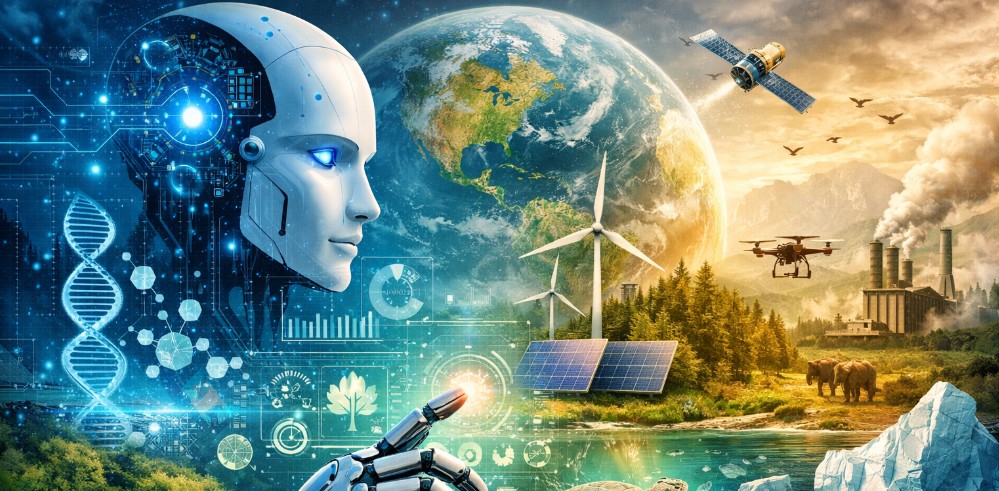
Artificial intelligence (AI) is transforming how we tackle some of the world’s most pressing scientific and environmental challenges. From climate modeling to wildlife conservation, AI’s ability to analyze vast datasets and uncover patterns is unlocking new opportunities for innovation and impact.
At its core, AI applies advanced algorithms and machine learning to automate complex tasks, accelerate research, and improve decision-making. For scientists and environmentalists, this means faster insights, more accurate predictions, and smarter resource management.
Accelerating Scientific Discoveries with AI
AI is reshaping scientific research by automating data analysis and enhancing experimental design. Machine learning models can sift through enormous datasets from physics experiments, genomics, or astronomy, identifying correlations that humans might miss.
For example, AI-driven simulations enable researchers to test hypotheses and explore scenarios without costly or time-consuming physical experiments. This accelerates discovery cycles and reduces barriers to innovation.
Moreover, AI supports collaboration by integrating diverse datasets from multiple sources. This holistic approach offers a more comprehensive understanding of complex phenomena, whether it’s exploring the human genome or studying materials at the atomic level.
AI’s Role in Tackling Environmental Challenges
Environmental science benefits significantly from AI’s predictive capabilities. Accurate climate models powered by AI help forecast weather extremes and long-term climate changes with improved precision. This supports better preparation and mitigation efforts at local and global scales.
In conservation, AI aids in monitoring wildlife populations through image recognition and sensor data analysis. Automated systems can detect poaching activities, track endangered species, and analyze habitats with minimal human intervention. This real-time intelligence enhances conservation strategies and resource allocation.
Water management, air quality monitoring, and renewable energy optimization also see major gains from AI applications, enabling smarter, data-driven environmental stewardship.
Practical Steps to Incorporate AI in Science and Environment Projects
- Define Clear Objectives: Focus on specific problems where AI can add measurable value, such as predicting outcomes or identifying anomalies.
- Leverage Quality Data: Ensure access to diverse and clean datasets to train reliable AI models.
- Partner with Experts: Collaborate with AI specialists who understand scientific and environmental contexts.
- Implement Scalable Solutions: Adopt flexible AI tools that grow with evolving research needs.
- Evaluate and Iterate: Continuously assess AI impact and refine methods for greater accuracy and relevance.
Embracing AI for a Sustainable Future
AI is more than a technological trend—it’s a vital tool for advancing science and protecting our environment. By harnessing its potential thoughtfully, we can unlock deeper insights, enable smarter solutions, and foster resilience in the face of complex global challenges.
At Enveos, we understand the importance of integrating innovative technologies like AI into digital strategies. Whether you’re in scientific research or environmental initiatives, we’re here to help you connect with the right resources and expertise to maximize your impact.
Ready to explore how AI can elevate your projects? Fill out the form below and let’s start a conversation tailored to your goals and community needs.
Stay Connected
Follow Enveos on social media for ongoing updates on AI applications, science, environment, and local digital innovation. Together, we can build smarter, more sustainable communities.